Fichier:Dipole antenna standing waves animation 1-10fps.gif
Aller à la navigation
Aller à la recherche
Pas de plus haute résolution disponible.
Dipole_antenna_standing_waves_animation_1-10fps.gif (682 × 311 pixels, taille du fichier : 170 kio, type MIME : image/gif, en boucle, 20 trames, 2,0 s)

Description
| Description |
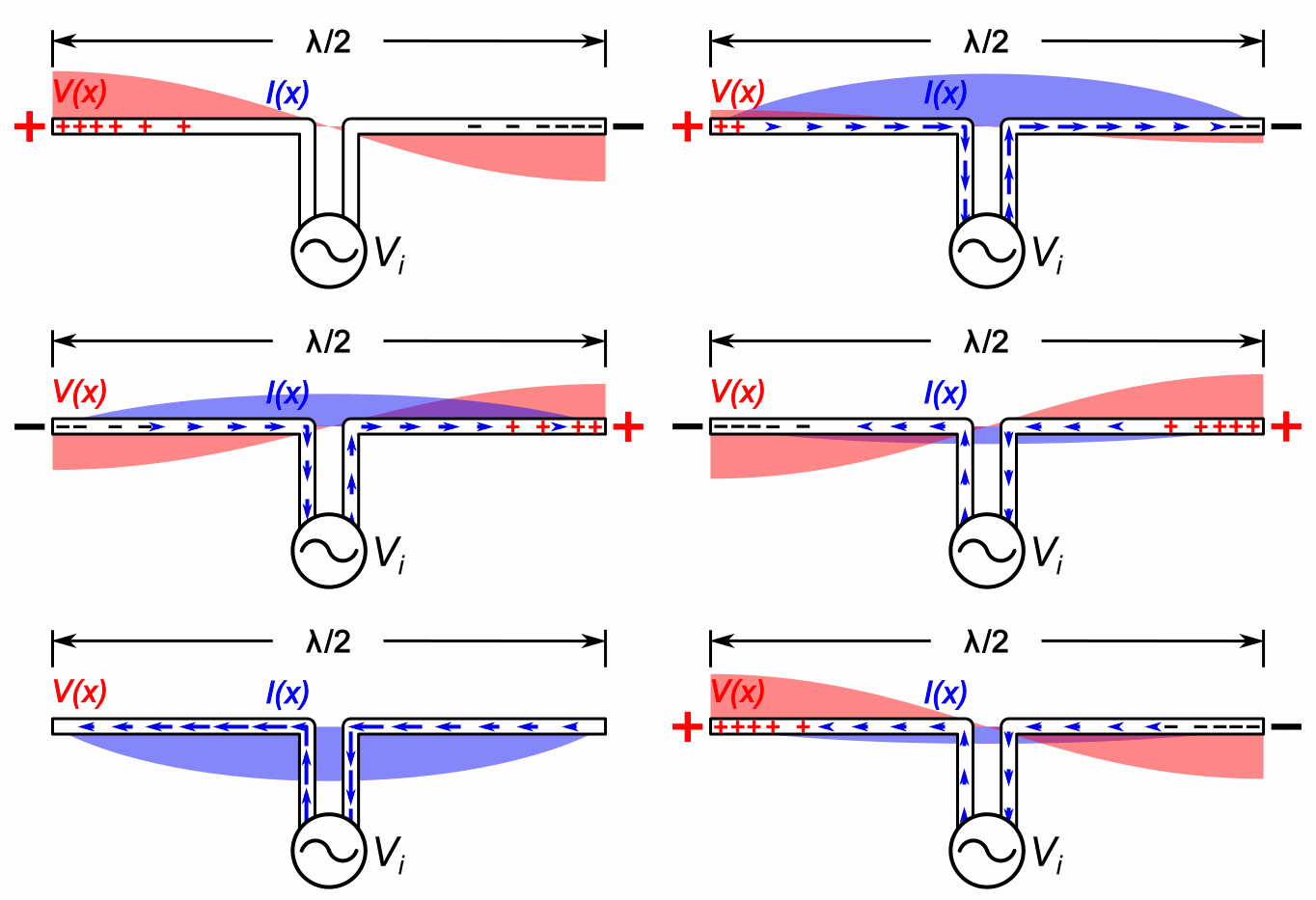
English: Animation showing standing waves on a half-wave dipole antenna driven by a sinusoidal voltage VO from a radio transmitter at its resonant frequency. The oscillating voltage pushes the electrons back and forth along the two metal rods that make up the antenna, creating oscillating currents (blue arrows) in the antenna, charging its ends alternately positive (+) and negative (-). Since at this frequency the antenna is a half wavelength (λ/2) long, a sinusoidal wave of voltage or current takes exactly one cycle to make the round trip from one end of the antenna to the other and back, so the reflected waves reinforce each other. The antenna acts like an electronic resonater. Waves of current and voltage reflecting back and forth between the ends of the rods interfere to form standing waves. The standing waves are shown graphically by bars of color (red for voltage V(x) and blue for current I(x)) whose width at each point is proportional to the amplitude of the wave at that point. There are voltage antinodes (maxima) and current nodes (zero points) at each end, where positive (+) and negative (−) charges accumulate alternately each half cycle, while there is a voltage node and current antinode at the drive point in the center. The large oscillating voltages and currents on the antenna at resonance causes it to radiate maximum radio wave power. The zero voltage reference for the voltage waves, as is customary in these graphs, is halfway between the voltage on the two transmission line conductors. The blue arrows show the direction of conventional current, flow of positive charge; the direction of flow of the electrons in the antenna is opposite to the arrows. The oscillations are shown slowed down enormously; the current in actual radio antennas oscillates back and forth between ten thousand and one billion cycles per second. |
| Date | |
| Source | Travail personnel |
| Auteur | Chetvorno |

|
Cette image circuit devrait être recréée sous forme vectorielle, dans un fichier d’animation SVG. Ceci a plusieurs avantages : voir Commons:Media for cleanup pour plus d’informations.
Si une forme SVG de cette image est disponible, veuillez la téléverser et ensuite remplacer ce modèle par {{Vector version available|nom de la nouvelle image}}. Il est recommandé de nommer le fichier SVG « Dipole antenna standing waves animation 1-10fps.svg » – alors le modèle Vector version available (ou Vva) n’a pas besoin du paramètre nom de la nouvelle image. |
Conditions d’utilisation
Moi, en tant que détenteur des droits d’auteur sur cette œuvre, je la publie sous la licence suivante :
 
|
Ce fichier est dans le domaine public selon les termes de la licence Creative Commons CC0 1.0 Universel. |
| La personne qui a associé une œuvre avec cet acte l’a placée dans le domaine public en renonçant mondialement à tous ses droits sur cette œuvre en vertu des lois relatives au droit d’auteur, ainsi qu’à tous les droits juridiques connexes et voisins qu’elle possédait sur l’œuvre, sans autre limite que celles imposées par la loi. Vous pouvez copier, modifier, distribuer et utiliser cette œuvre, y compris à des fins commerciales, sans qu’il soit nécessaire d’en demander la permission.
|
Historique du fichier
Cliquer sur une date et heure pour voir le fichier tel qu'il était à ce moment-là.
| Date et heure | Vignette | Dimensions | Utilisateur | Commentaire | |
|---|---|---|---|---|---|
| actuel | 9 juillet 2020 à 06:00 | | 682 × 311 (170 kio) | wikimediacommons>Chetvorno | Improved current arrows, made motion less jerky, added plus and minus charges in antenna |
Utilisation du fichier
La page suivante utilise ce fichier :
