Fichier:Exoplanet Period-Mass Scatter Kepler.png

Description
| Description |
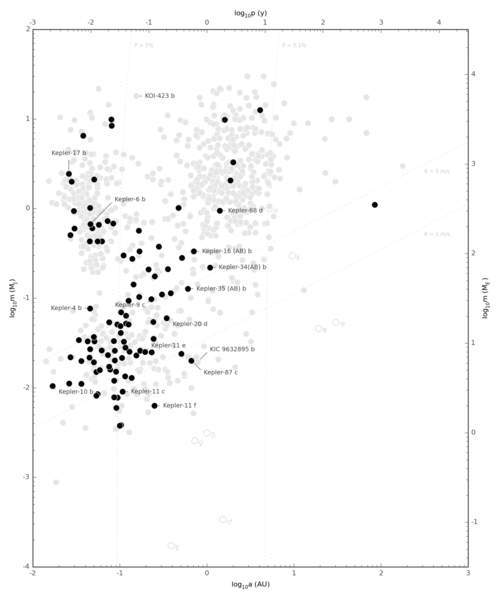
English: Scatter plot of mass, m, and semimajor axis, a, for exoplanet discoveries through 2014-09-23, indicating exoplanets detected by the Kepler Mission:
planets detected by Kepler (black, labeled)
other exoplanets
Solar System planets for reference
Estimates (see "important note" below) of m and a are indicated with circles. Scales indicate (log10 of) mass, m, expressed as Jupiter masses (left) and Earth masses (right); and (log10 of) semimajor axis, a, expressed in AU (bottom), and the corresponding period, p for a planet orbiting a Sun-mass star, expressed in Earth years. Reference lines are provided as a rough measure of the difficulty of detecting exoplanets using transits. Dashed lines trace the m (for Jupiter-density) and a values where the geometric probability, P, of transit for a solar-radius star (assuming a circular orbit, so that e and ω can be ignored) is the indicated value (less than the indicated proportion of all planets to the right of a given line will have transiting orbits). Exoplanet data is from the Open Exoplanet Catalogue,[1] version 811d352, including some (mostly from the Kepler mission) whose semi major axes are computed from period data. The figure excludes 4 planets with semimajor axes outside the range of the figure and 1 (PSR B1257+12 b) with a mass lower than the range of the figure. Important note: This figure is intended to serve as a visualization of the catalog of generally accepted candidate exoplanets using the distribution of some of their basic properties related to detection. No attempt has been made to characterize the degree of confidence (which varies widely) in the existence of a given planet or its properties. Nor is any attempt made to convey systematic errors associated with a particular method. In particular, the indicated mass, m, for an exoplanet characterized using radial velocity is the minimum mass (so that the actual distrubiton of masses for non-transiting planets may be shifted and "smeared" significantly upward).
|
| Date | |
| Source | Travail personnel, based on a figure by E.A.L. and used with permission |
| Auteur | Aldaron, a.k.a. Aldaron |
| Autres versions |
Other versions
Graphs for individual methods
Related graphs
|




Conditions d’utilisation :

|
Moi, propriétaire des droits d’auteur sur cette œuvre, la place dans le domaine public. Ceci s'applique dans le monde entier. Dans certains pays, ceci peut ne pas être possible ; dans ce cas : J’accorde à toute personne le droit d’utiliser cette œuvre dans n’importe quel but, sans aucune condition, sauf celles requises par la loi. |
Historique du fichier
Cliquer sur une date et heure pour voir le fichier tel qu'il était à ce moment-là.
| Date et heure | Vignette | Dimensions | Utilisateur | Commentaire | |
|---|---|---|---|---|---|
| actuel | 26 septembre 2016 à 23:10 | | 1 600 × 1 920 (79 kio) | wikimediacommons>Cmdrjameson | Compressed with pngout. Reduced by 167kB (67% decrease). |
Utilisation du fichier
La page suivante utilise ce fichier :
