Fichier:Galilean satellite triple conjunction 2015-01-24.jpg
Description
| Description |
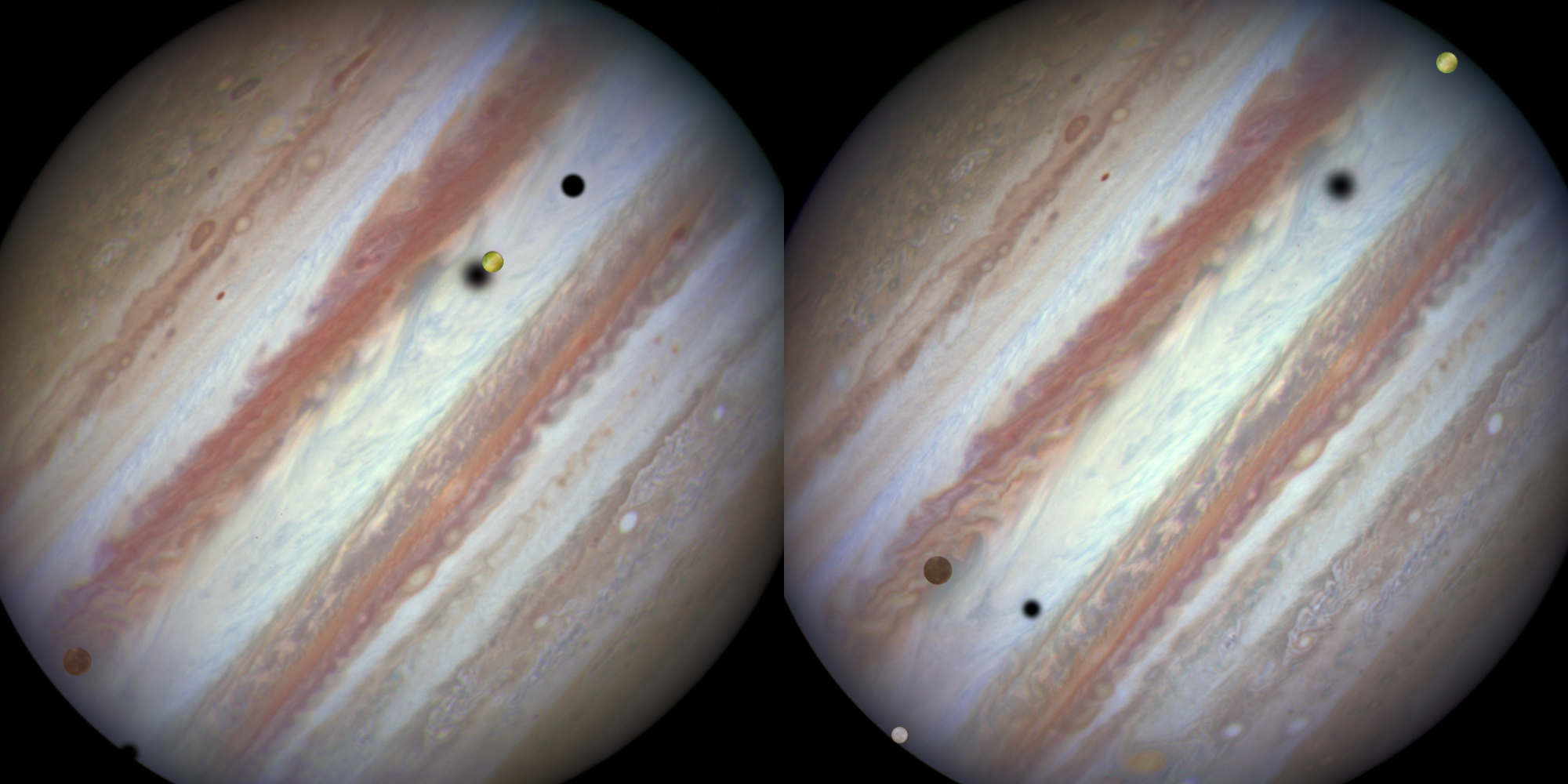
English: Firing off a string of snapshots like a sports photographer at a NASCAR race, NASA's Hubble Space Telescope captured a rare look at three of Jupiter's largest moons parading across the banded face of the gas-giant planet: Europa, Callisto, and Io.
These so-called Galilean satellites (named after the 17th century scientist Galileo Galilei, who discovered them with a telescope) complete orbits around Jupiter ranging from 2 days to 17 days in duration. They can commonly be seen transiting the face of Jupiter and casting shadows onto its cloud tops. However, seeing three moons transiting the face of Jupiter at the same time is rare, occurring only once or twice a decade. The Hubble image on the left shows the beginning of the event, which took place on January 24, 2015. From left to right the moons Callisto and Io are above Jupiter's cloud tops. The shadows from Europa (not seen in the image), Callisto, and Io are strung out from left to right. Near the end of the event, approximately 42 minutes later (right-side image), Europa has entered the frame at lower left. Slower-moving Callisto is above and to the right of Europa. Fastest-moving Io is approaching the eastern limb of the planet; its shadow is no longer visible on Jupiter. Europa's shadow is toward the left side of the image, and Callisto's shadow to the right. (The moons' orbital velocities are proportionally slower with increasing distance from the planet.) Missing from the sequence is the moon Ganymede, which was outside Hubble's field of view and too far from Jupiter in angular separation to be considered part of the conjunction. The moons in these photos have distinctive colors. The ancient, cratered surface of Callisto is brownish; the smooth icy surface of Europa is yellow-white; and the volcanic, sulfur-dioxide surface of Io is orange. The apparent "fuzziness" of some of the shadows depends on the moons' distances from Jupiter. The farther away a moon is from the planet, the softer the shadow, because the shadow is more spread out across the disk. The images were taken with Hubble's Wide Field Camera 3 in visible light. |
| Date | (released 5 February 2015) |
| Source | http://hubblesite.org/newscenter/archive/releases/2015/05/image/b/ and http://hubblesite.org/newscenter/archive/releases/2015/05/image/c/ (see also http://heritage.stsci.edu/2015/05/index.html) |
| Auteur | NASA, ESA, and the Hubble Heritage Team (STScI/AURA) |
| Autres versions |

.jpg)


Conditions d’utilisation

|
Ce fichier provient de la NASA. Sauf exception, les documents créés par la NASA ne sont pas soumis à copyright. Pour plus d'informations, voir la politique de copyright de la NASA. |  |
 |
Attention :
|
Historique du fichier
Cliquer sur une date et heure pour voir le fichier tel qu'il était à ce moment-là.
| Date et heure | Vignette | Dimensions | Utilisateur | Commentaire | |
|---|---|---|---|---|---|
| actuel | 8 février 2015 à 00:00 | | 2 000 × 1 000 (1,02 Mio) | wikimediacommons>WolfmanSF | User created page with UploadWizard |
Utilisation du fichier
La page suivante utilise ce fichier :
