Fichier:Ngc2392.jpg
Description
|


| Description |
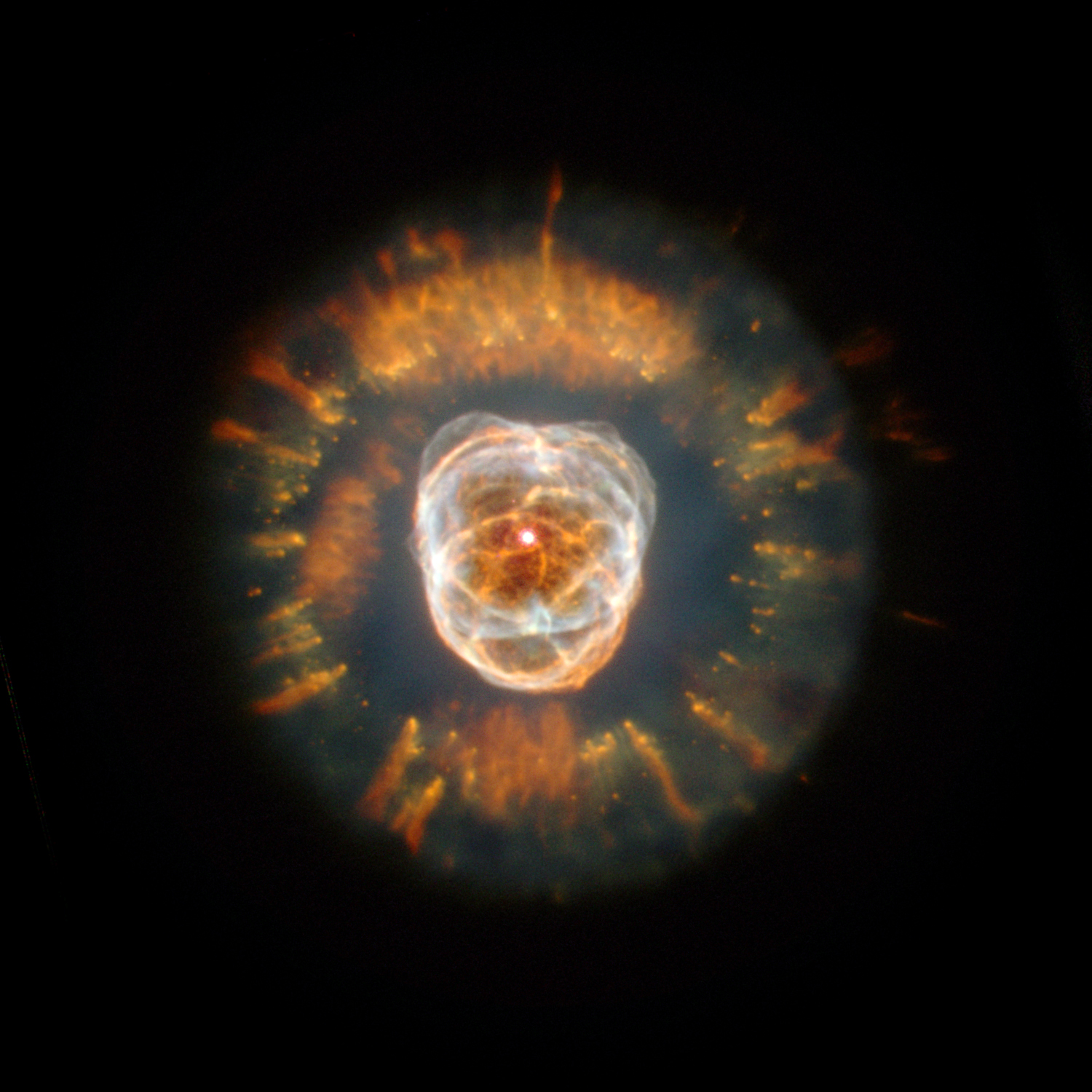
English: Eskimo nebula (NGC 2392). In its first glimpse of the heavens following the successful December 1999 servicing mission, NASA's Hubble Space Telescope captured a majestic view of a planetary nebula, the glowing remains of a dying, Sun-like star. This stellar relic, first spied by William Herschel in 1787, is nicknamed the "Eskimo" Nebula (NGC 2392) because, when viewed through ground-based telescopes, it resembles a face surrounded by a fur parka.
In this Hubble telescope image, the "parka" is really a disk of material embellished with a ring of comet-shaped objects, with their tails streaming away from the central, dying star. The Eskimo's "face" also contains some fascinating details. Although this bright central region resembles a ball of twine, it is, in reality, a bubble of material being blown into space by the central star's intense "wind" of high-speed material. In this photo, one bubble lies in front of the other, obscuring part of the second lobe. Scientists believe that a ring of dense material around the star's equator, ejected during its red giant phase, created the nebula's shape. The bubbles are not smooth like balloons but have filaments of denser matter. Each bubble is about 1 light-year long and about half a light-year wide. Scientists are still puzzled about the origin of the comet-shaped features in the "parka." One possible explanation is that these objects formed from a collision of slow-and fast-moving gases. The Eskimo Nebula is more than 2,870 light-years from Earth in the constellation Gemini. The picture was taken Jan. 10 and 11, 2000, with the Wide Field and Planetary Camera 2. The nebula's glowing gases produce the colors in this image: nitrogen (red), hydrogen (green), oxygen (blue), and helium (violet). |
||
| Date | |||
| Source | http://www.spacetelescope.org/images/heic9910a/ | ||
| Auteur | NASA, ESA, Andrew Fruchter (STScI), and the ERO team (STScI + ST-ECF) | ||
| Autorisation (Réutilisation de ce fichier) |
|
||
| Autres versions | Œuvres dérivées de ce fichier : EvolutionSystèmeSolaire-fragment1.png |




Historique du fichier
Cliquer sur une date et heure pour voir le fichier tel qu'il était à ce moment-là.
| Date et heure | Vignette | Dimensions | Utilisateur | Commentaire | |
|---|---|---|---|---|---|
| actuel | 28 juillet 2005 à 13:34 | | 1 500 × 1 500 (1,16 Mio) | wikimediacommons>Startaq |
Utilisation du fichier
La page suivante utilise ce fichier :
