Fichier:PIA18469-AsteroidCollision-NearStarNGC2547-ID8-2013.jpg


Description
| Description |
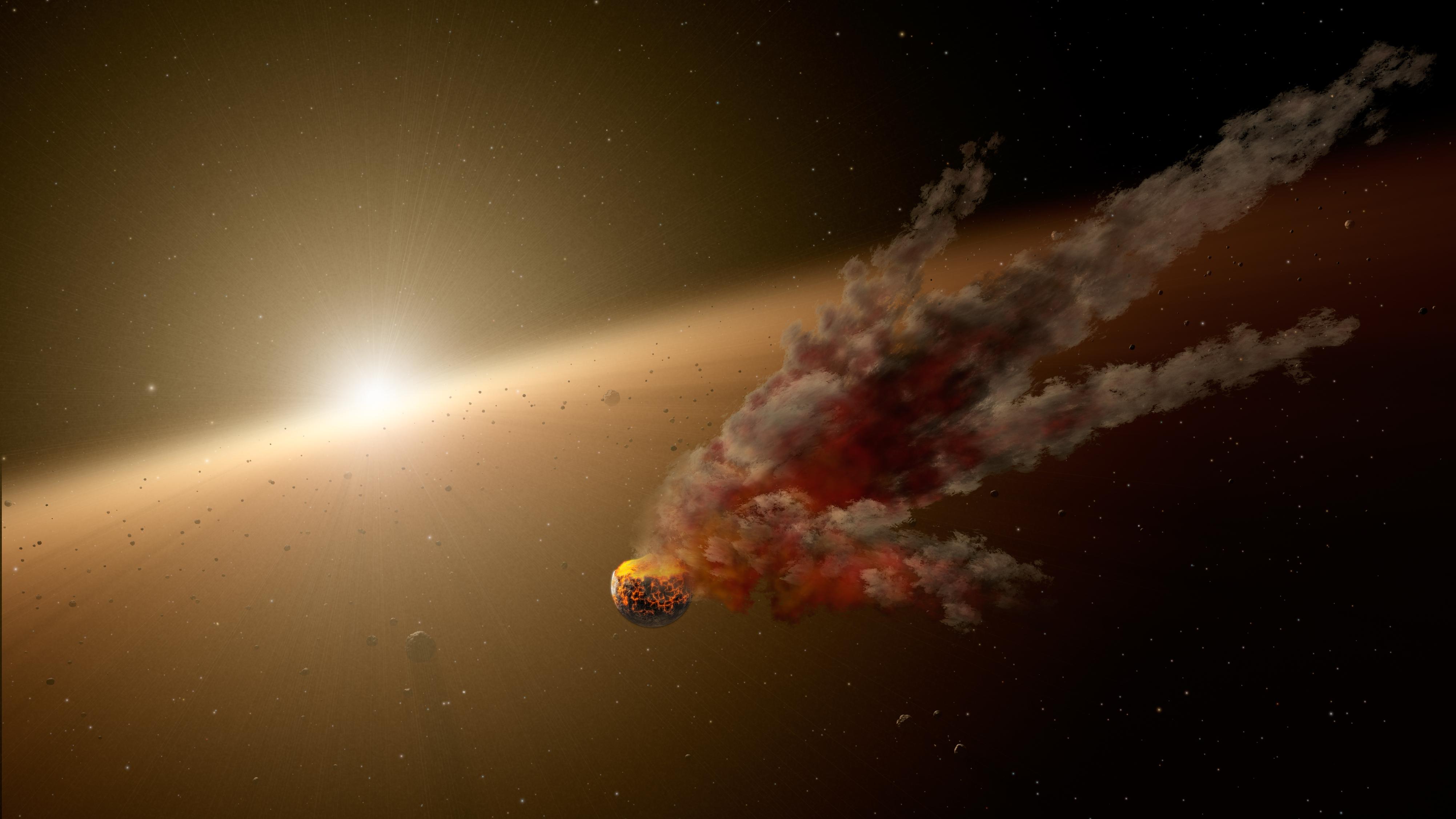
English: Building Planets Through Collisions (Artist's Concept)
http://www.jpl.nasa.gov/spaceimages/details.php?id=pia18469 http://www.jpl.nasa.gov/news/news.php?release=2014-291 http://www.nasa.gov/press/2014/august/nasas-spitzer-telescope-witnesses-asteroid-smashup/ http://www.nasa.gov/jpl/spitzer/pia18470/ Planets, including those like our own Earth, form from epic collisions between asteroids and even bigger bodies, called proto-planets. Sometimes the colliding bodies are ground to dust, and sometimes they stick together to ultimately form larger, mature planets. This artist's conception shows one such smash-up, the evidence for which was collected by NASA's Spitzer Space Telescope. Spitzer's infrared vision detected a huge eruption around the star NGC 2547-ID8 between August 2012 and 2013. Scientists think the dust was kicked up by a massive collision between two large asteroids. They say the smashup took place in the star's "terrestrial zone," the region around stars where rocky planets like Earth take shape. NGC 2547-ID8 is a sun-like star located about 1,200 light-years from Earth in the constellation Vela. It is about 35 million years old, the same age our young sun was when its rocky planets were finally assembled via massive collisions – including the giant impact on proto-Earth that led to the formation of the moon. The recent impact witnessed by Spitzer may be a sign of similar terrestrial planet building. Near-real-time studies like these help astronomers understand how the chaotic process works. NASA's Jet Propulsion Laboratory, Pasadena, Calif., manages the Spitzer Space Telescope mission for NASA's Science Mission Directorate, Washington. Science operations are conducted at the Spitzer Science Center at the California Institute of Technology in Pasadena. Spacecraft operations are based at Lockheed Martin Space Systems Company, Littleton, Colorado. Data are archived at the Infrared Science Archive housed at the Infrared Processing and Analysis Center at Caltech. Caltech manages JPL for NASA. For more information about Spitzer, visit http://spitzer.caltech.edu and http://www.nasa.gov/spitzer.Afrikaans: Die bou van planete deur botsings ('n kunstenaarskonsep)
Planete, insluitend dié soos ons eie Aarde, vorm uit epiese botsings tussen asteroïdes en selfs groter liggame, die protoplanete. Soms word die botsende liggame tot stof verpulwer, en soms kleef hulle aan mekaar vas om eindelik groter, volwasse planete te vorm. Hierdie kunstenaar se konsepsie toon een sodanige botsing, waarvan bewyse deur NASA se Spitzer-ruimteteleskoop versamel is. Spitzer se infrarooisig het tussen Augustus 2012 en 2013 'n groot uitbarsting rondom die ster NGC 2547-ID8 waargeneem. Wetenskaplikes dink dat die stof deur 'n massiewe botsing tussen twee groot asteroïdes opgeskop is. Hulle sê die botsing het in die ster se "aardse sone" plaasgevind, die gebied rondom sterre waar rotsagtige planete soos die Aarde vorm aanneem. NGC 2547-ID8 is 'n sonagtige ster wat ongeveer 1 200 ligjare van die Aarde af in die sterrebeeld Vela geleë is. Dit is omtrent 35 miljoen jaar oud, dieselfde ouderdom as wat ons jong son was toe sy rotsagtige planete uiteindelik deur massiewe botsings saamgestel is – insluitend die reuse-impak op die proto-Aarde wat tot die vorming van die Maan gelei het. Die onlangse impak wat Spitzer aanskou het, kan 'n teken wees van soortgelyke aardse planeetbou. Byna-intydse studies soos hierdie help sterrekundiges om hierdie chaotiese proses te verstaan. NASA se Jet Propulsion Laboratory (JPL) in Pasadena, Kalifornië, bestuur die Spitzer-ruimteteleskoopmissie vir NASA se Wetenskapmissiedirektoraat in Washington. Wetenskapbedrywighede word by die Spitzer-wetenskapsentrum by die California Institute of Technology in Pasadena uitgevoer. Ruimtetuigbedrywighede is by Lockheed Martin Space Systems Company in Littleton, Colorado, gebaseer. Data word by die Infrarooi-wetenskapargief geargiveer wat by die Infrarooi Verwerkings- en Analisesentrum by Caltech gehuisves word. Caltech bestuur JPL vir NASA. Vir meer inligting omtrent Spitzer, kyk spitzer.caltech.edu en nasa.gov/spitzer. |
| Date | |
| Source | http://photojournal.jpl.nasa.gov/jpeg/PIA18469.jpg |
| Auteur | NASA/JPL-Caltech |
Conditions d’utilisation

|
Le détenteur des droits d’auteur de ce fichier, NASA/JPL-Caltech, autorise n’importe qui à l’utiliser pour n’importe quelle utilisation, pourvu que le détenteur des droits d’auteur soit correctement attribué. La redistribution, les œuvres dérivées, l’utilisation commerciale et toutes les autres utilisations sont autorisées. |
|
|
 
|
According to JPL's image use policy additional restriction is that no endorsement of any product or service by Caltech, JPL or NASA is claimed or implied.
Caltech's disclaimer: Caltech makes no representations or warranties with respect to ownership of copyrights in the images, and does not represent others who may claim to be authors or owners of copyright of any of the images, and makes no warranties as to the quality of the images. Caltech shall not be responsible for any loss or expenses resulting from the use of the images, and you release and hold Caltech harmless from all liability arising from such use. Usage on the English Wikipedia: On the English Wikipedia you can use the {{JPL Image}} template to display the copyright notice. (See w:Wikipedia:Using JPL images for details) |
Historique du fichier
Cliquer sur une date et heure pour voir le fichier tel qu'il était à ce moment-là.
| Date et heure | Vignette | Dimensions | Utilisateur | Commentaire | |
|---|---|---|---|---|---|
| actuel | 24 avril 2019 à 19:06 | | 4 005 × 2 253 (1,86 Mio) | wikimediacommons>FriedrichKieferer | Better quality. |
Utilisation du fichier
La page suivante utilise ce fichier :
