Fichier:Sombrero Galaxy in infrared light (Hubble Space Telescope and Spitzer Space Telescope).jpg
Description
| Description |
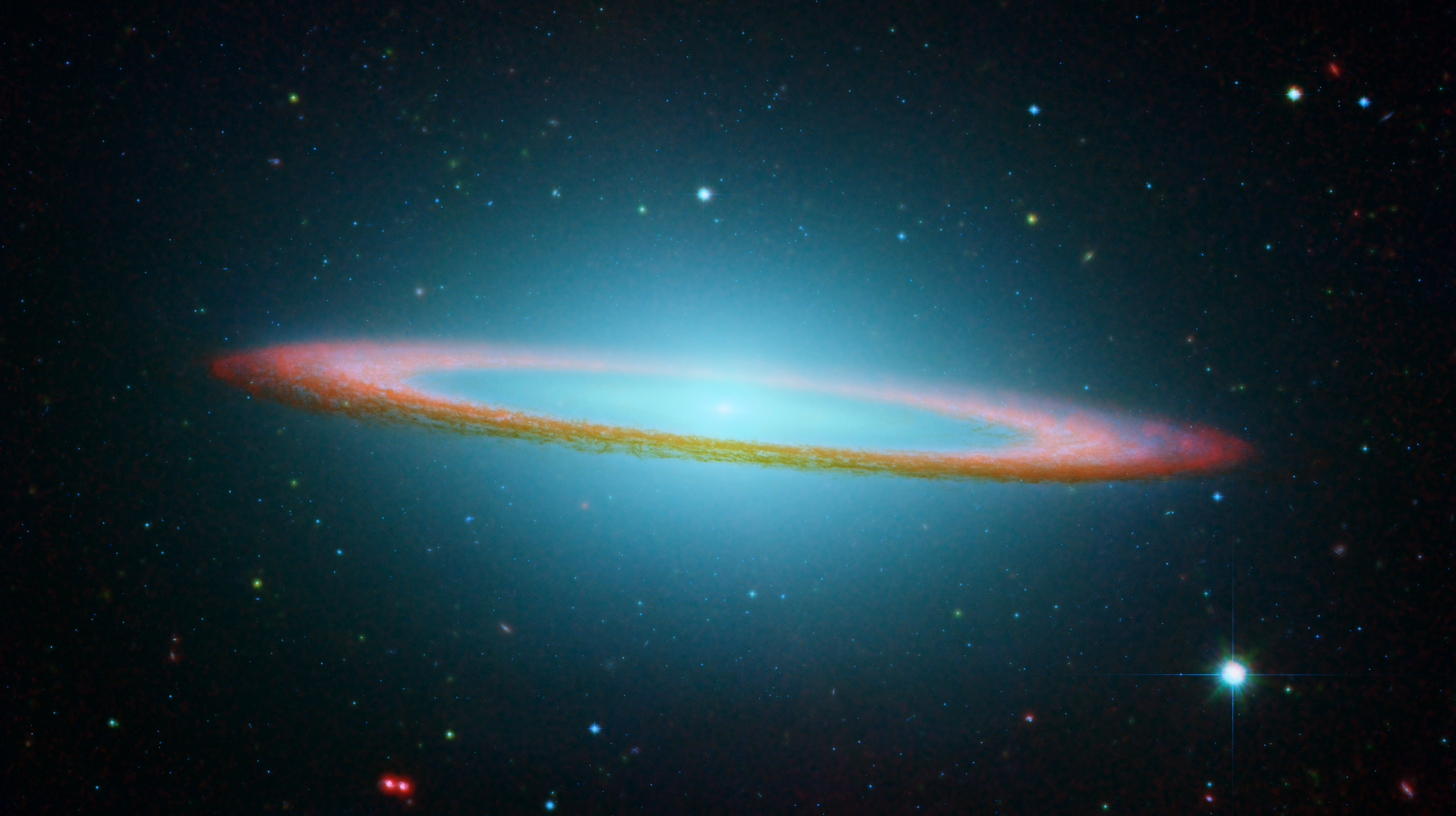
English: NASA/ESA Hubble Space Telescope and NASA's Spitzer Space Telescope joined forces to create this striking composite image of one of the most popular sights in the universe. Messier 104 is commonly known as the Sombrero galaxy because in visible light, it resembles the broad-brimmed Mexican hat. However, in Spitzer's striking infrared view, the galaxy looks more like a "bull's eye."
Spitzer's full view shows the disk is warped, which is often the result of a gravitational encounter with another galaxy, and clumpy areas spotted in the far edges of the ring indicate young star-forming regions. The Sombrero galaxy is located some 28 million light-years away. Viewed from Earth, it is just six degrees south of its equatorial plane. Spitzer detected infrared emission not only from the ring, but from the center of the galaxy too, where there is a huge black hole, believed to be a billion times more massive than our Sun. The Spitzer picture is composed of four images taken at 3.6 (blue), 4.5 (green), 5.8 (orange), and 8.0 (red) microns. The contribution from starlight (measured at 3.6 microns) has been subtracted from the 5.8 and 8-micron images to enhance the visibility of the dust features.Français : Le Hubble de la NASA/de l'ASE et le Spitzer de la NASA combinent leurs forces pour créer cette image composite de l'une des plus célèbres vues de l'univers. Messier 104 est communément connu sous le nom Galaxie du Sombrero car dans cette lumière visible, il ressemble aux larges bords d'un chapeau mexicain. Cependant, dans la perception infrarouge du Splitzer, la galaxie ressemble plus à une "cible".
La galaxie du Sombrero est localisée à 28 millions d'années lumières. Vue de la terre, elle est juste à six degrés sud de sa trajectoire équatoriale. Spitzer détecte une émission infrarouge pas seulement depuis le cercle, mais également du centre de la galaxie, dans lequel se trouve un énorme trou noir, un milliard de fois plus gros que notre soleil. L'image du Splitzer est composée de quatre images prises à 3.6 (bleu), 4.5 (vert), 5.8 (orange) et 8.0 (rouge) microns. |
| Date | entre mai 2003 et juin 2003 |
| Source | |
| Auteur | NASA/JPL-Caltech and The Hubble Heritage Team (STScI/AURA) |
| Autres versions |
 |
|



.jpg)


.jpg)

|
Deutsch: Dieses Bild wurde als Bild der Woche auf der tschechischen Wikipedia für die 36. Woche 2017 ausgewählt. English: This image was selected as a picture of the week on the Czech Wikipedia for 36th week, 2017. Français : Cette image est sélectionnée en tant qu’image de la semaine sur la Wikipédia Tchèque pour la 36e semaine de 2017. Italiano: Questa immagine è stata selezionata come Immagine della settimana su Wikipedia in ceco per la XXXVI settimana del 2017. Македонски: Сликава е избрана за слика на неделата на чешката Википедија за XXXVI недела од 2017 година. Русский: Эта иллюстрация была выбрана изображением недели в чешском разделе «Википедии» для недели номер 36 2017 года. Українська: Ця ілюстрація була вибрана зображенням тижня в чеському розділі «Вікіпедії» для тижня номер 36, 2017 року. |
|
Conditions d’utilisation

|
This file is in the public domain because it was created by NASA and ESA. NASA Hubble material (and ESA Hubble material prior to 2009) is copyright-free and may be freely used as in the public domain without fee, on the condition that only NASA, STScI, and/or ESA is credited as the source of the material. This license does not apply if ESA material created after 2008 or source material from other organizations is in use.
The material was created for NASA by Space Telescope Science Institute under Contract NAS5-26555, or for ESA by the Hubble European Space Agency Information Centre. Copyright statement at hubblesite.org or 2008 copyright statement at spacetelescope.org. For material created by the European Space Agency on the spacetelescope.org site since 2009, use the {{ESA-Hubble}} tag. |
Historique du fichier
Cliquer sur une date et heure pour voir le fichier tel qu'il était à ce moment-là.
| Date et heure | Vignette | Dimensions | Utilisateur | Commentaire | |
|---|---|---|---|---|---|
| actuel | 20 juillet 2009 à 21:46 | | 3 000 × 1 681 (3,98 Mio) | wikimediacommons>Tryphon | {{Information |Description=NASA/ESA Hubble Space Telescope and NASA's Spitzer Space Telescope joined forces to create this striking composite image of one of the most popular sights in the universe. Messier 104 is commonly known as the Sombrero galaxy bec |
Utilisation du fichier
La page suivante utilise ce fichier :
.jpg)