Fichier:Sphere wireframe.svg
Aller à la navigation
Aller à la recherche
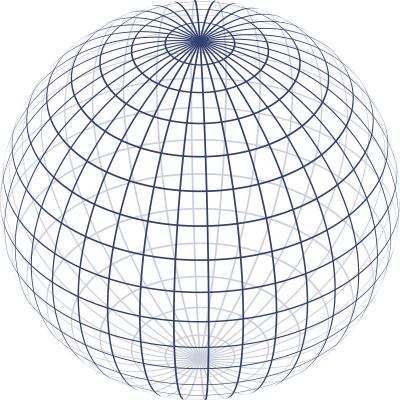
Taille de cet aperçu PNG pour ce fichier SVG : 400 × 400 pixels. Autres résolutions : 240 × 240 pixels | 480 × 480 pixels | 768 × 768 pixels | 1 024 × 1 024 pixels | 2 048 × 2 048 pixels.


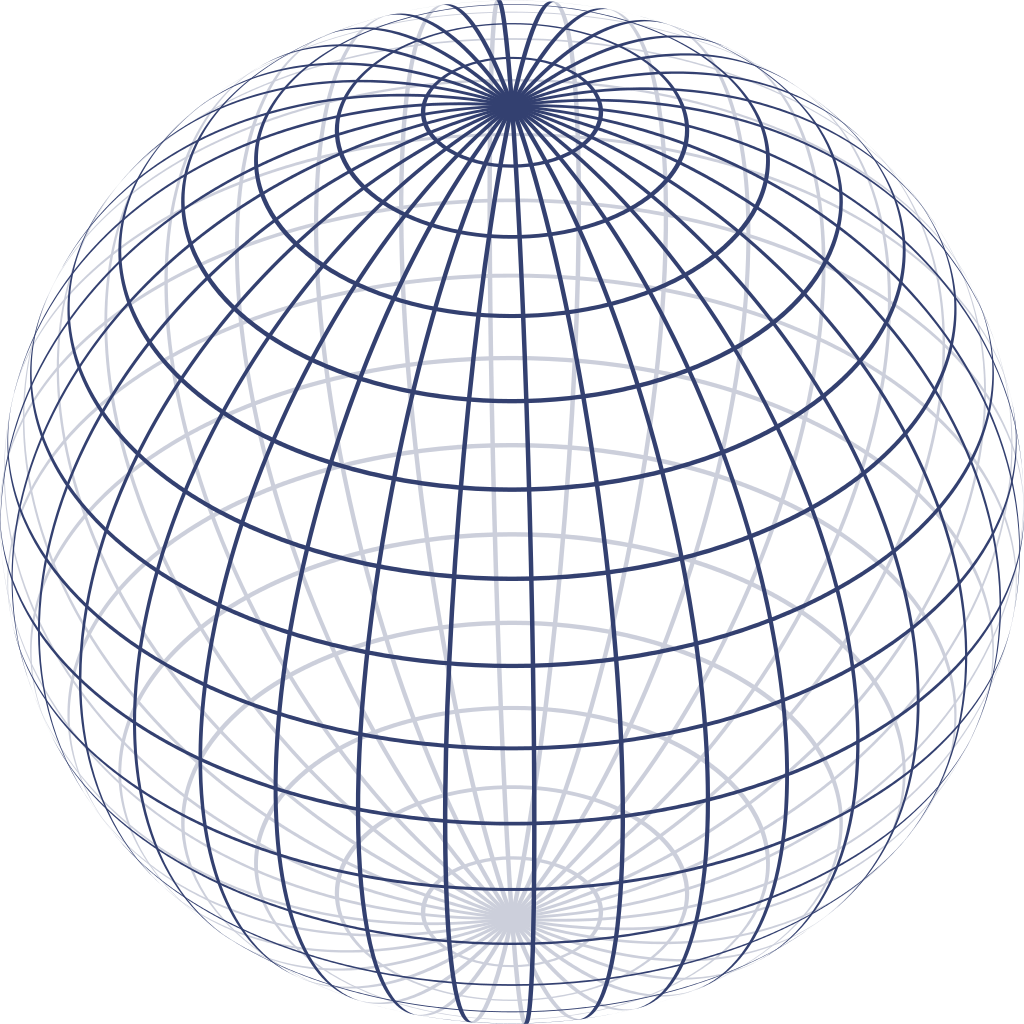
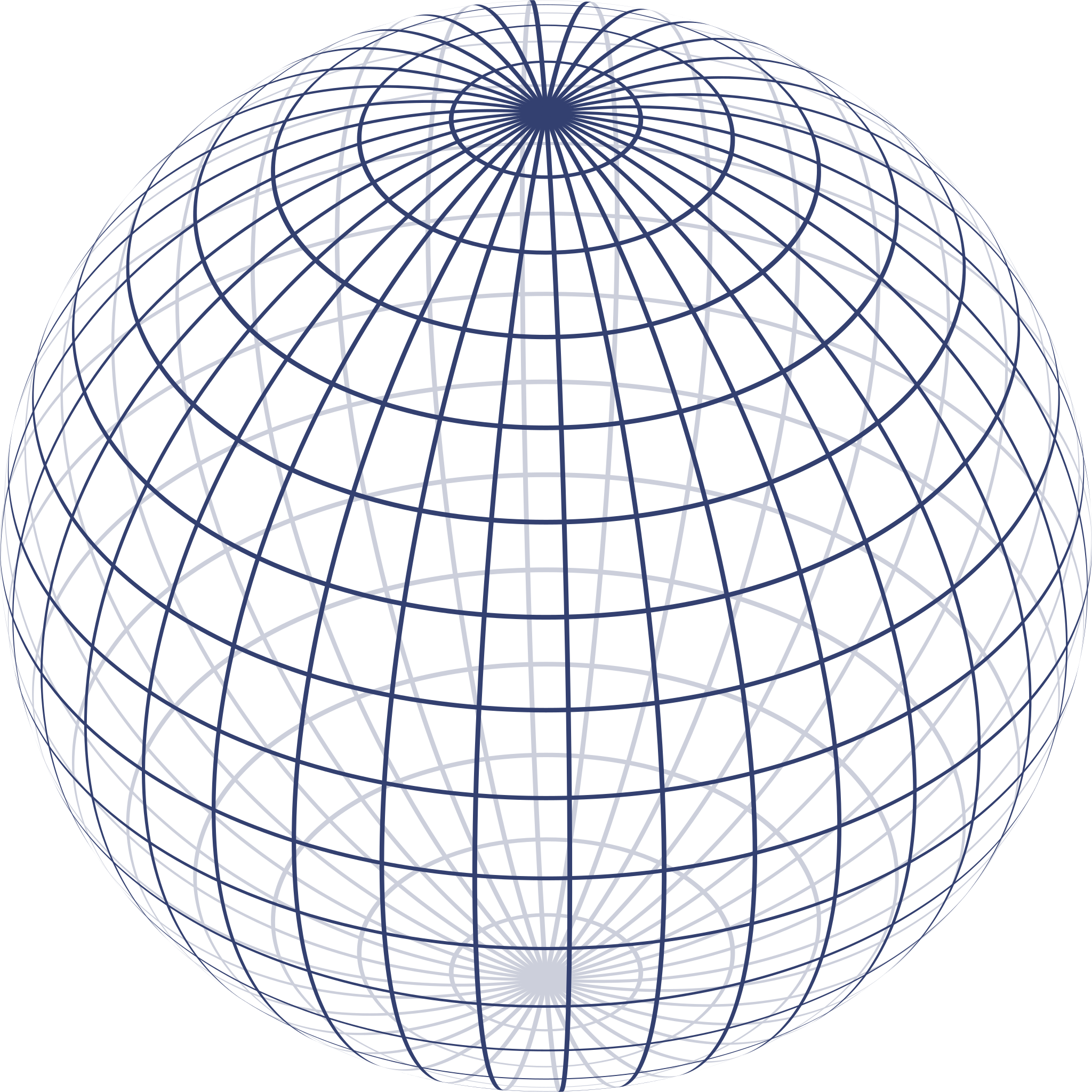
Fichier d’origine (Fichier SVG, nominalement de 400 × 400 pixels, taille : 8 kio)

Description
| Description |
English: Sphere wireframe - orthogonal projection of a sphere. The image shows lines, which are drawn as they were painted onto the surface of a sphere. The angular distance between two lines is 10°. The SVG file is created by the below C++-program, which calculates each edge of a line as an ellipse-bow. The backside of the sphere has an opacity of 0.25. The axis tilt is 52.5°. |
| Date | |
| Source | Travail personnel |
| Auteur | Geek3 |
| Autres versions | Sphere wireframe 10deg 10r.svg |


 W3C-validity not checked.
Source Code
This image can be completely generated by the following source code. If you have the gnu compiler collection installed, the programm can be compiled by the following commands:
g++ sphere_wireframe.cpp -o sphere_wireframe
and run :
./sphere_wireframe > Sphere_wireframe.svg
It creates file Sphere_wireframe.svg in working directory. This file can be viewed using rsvg-view program :
rsvg-view Sphere_wireframe.svg
Here is cpp code in file : sphere_wireframe.cpp
/* sphere - creates a svg vector-graphics file which depicts a wireframe sphere
 *
 * Copyright (C) 2008 Wikimedia foundation
 *
 * This program is free software; you can redistribute it and/or modify
 * it under the terms of the GNU General Public License as published by
 * the Free Software Foundation; either version 2, or (at your option)
 * any later version.
 *
 * This program is distributed in the hope that it will be useful,
 * but WITHOUT ANY WARRANTY; without even the implied warranty of
 * MERCHANTABILITY or FITNESS FOR A PARTICULAR PURPOSE.  See the
 * GNU General Public License for more details.
 *
 * You should have received a copy of the GNU General Public License
 * along with this program; if not, you can either send email to this
 * program's author (see below) or write to:
 *   The Free Software Foundation, Inc.
 *   51 Franklin Street, Fifth Floor
 *   Boston, MA 02110-1301  USA
 */

/* The expressions in this code are not proven to be correct.
 * Hence this code probably contains lots of bugs. Be aware! */

#include <iostream>
#include <cmath>
#include <cstdlib>
#include <cstring>

using namespace std;

const double PI = 3.1415926535897932;
const double DEG = PI / 180.0;

/********************************* settings **********************************/
int n_lon = 18; 			// number of latitude fields (18 => 10° each)
int n_lat = 18; 			// half number of longitude fields (18 => 10° each)
double lon_offset = 2.5 * DEG; 	// offset of the meridians
double w = 52.5 * DEG; 		// axial tilt (0° => axis is perpendicular to image plane)
double stripe_grad = 0.5 * DEG;	// width of each line
int image_size = 400;			// width and height of the image in pixels
double back_opacity = 0.25;		// opacity of the sphere's backside
char color[] = "#334070";		// color of lines
int istep = 2; 			// svg code indentation step
/*****************************************************************************/

double sqr(double x)
{
	return(x * x);
}

// commands for svg-code:
void indent(int n, bool in_tag = false)
{
	n *= istep;
	if (in_tag) n += istep + 1;
	for (int i = 0; i < n; i++) cout << " ";
}
void M()
{
	cout << "M ";
}
void Z()
{
	cout << "Z ";
}
void xy(double x, double y)
{
	cout << x << ",";
	cout << y << " ";
}
void arc(double a, double b, double x_axis_rot, bool large_arc, bool sweep)
{	// draws an elliptic arc
	if (b < 0.5E-6)
	{	// flat ellipses are not rendered properly => use line
		cout << "L ";
	}
	else
	{
		cout << "A ";
		cout << a << ",";	// semi-major axis
		cout << b << " ";	// semi-minor axis
		cout << x_axis_rot << " ";
		cout << large_arc << " ";
		cout << sweep << " ";
	}
}
void circle(bool clockwise)
{
	M();
	xy(-1, 0);
	arc(1, 1, 0, 0, !clockwise);
	xy(1, 0);
	arc(1, 1, 0, 0, !clockwise);
	xy(-1, 0);
	Z();
}

void start_svg_file()
{
	cout << "<?xml version=\"1.0\" encoding=\"UTF-8\" standalone=\"no\"?>\n";
	cout << "<svg id=\"Sphere_wireframe\"\n";
	cout << "  version=\"1.1\"\n";
	cout << "  baseProfile=\"full\"\n";
	cout << "  xmlns=\"http://www.w3.org/2000/svg\"\n";
	cout << "  xmlns:xlink=\"http://www.w3.org/1999/xlink\"\n";
	cout << "  width=\"" << image_size << "\"\n";
	cout << "  height=\"" << image_size << "\">\n\n";
	cout << "  <title>Sphere wireframe</title>\n\n";
	cout << "  <desc>\n";
	cout << "     about: http://commons.wikimedia.org/wiki/Image:Sphere_wireframe.svg\n";
	cout << "     rights: GNU Free Documentation license,\n";
	cout << "             Creative Commons Attribution ShareAlike license\n";
	cout << "  </desc>\n\n";
	cout << "  <g id=\"sphere\" transform=\"scale(" << 0.5 * image_size;
	cout << ", " << -0.5 * image_size << ") translate(1, -1)\">\n";
}

void end_svg_file()
{
	cout << "  </g>\n</svg>\n";
}


int main (int argc, char *argv[])
{
	// accept -lat and -lon as parameter
	for (int i = 2; i < argc; i++)
	{
		if (isdigit(argv[i][0]) || (sizeof(argv[i]) > sizeof(char)
			&& isdigit(argv[i][1])
			&& (argv[i][0] == '.' || argv[i][0] == '-')))
		{
			if (strcmp(argv[i - 1], "-lon") == 0)
			{
				lon_offset = atof(argv[i]) * DEG;
			}
			if (strcmp(argv[i - 1], "-lat") == 0)
			{
				w = atof(argv[i]) * DEG;
			}
		}
	}
	double cosw = cos(w), sinw = sin(w);
	double d = 0.5 * stripe_grad;

	start_svg_file();
	int ind = 2; // initial indentation level
	indent(ind);
	cout << "<g id=\"sphere_back\" transform=\"rotate(180)\" ";
	cout << "opacity=\"" << back_opacity << "\">\n";
	indent(++ind);
	cout << "<g id=\"sphere_half\">\n";

	// meridians
	indent(++ind); cout << "<g id=\"meridians\"\n";
	indent(ind++, true);
	cout << "style=\"stroke:none; fill:" << color << "; fill_rule:evenodd\">\n";
	double a = abs(cos(d));
	for (int i_lon = 0; i_lon < n_lat; i_lon++)
	{	// draw one meridian
		double longitude = lon_offset + (i_lon * 180.0 / n_lat) * DEG;
		double lon[2];
		lon[0] = longitude + d;
		lon[1] = longitude - d;

		indent(ind);
		cout << "<path id=\"meridian";
		cout << i_lon << "\"\n";
		indent(ind, true);
		cout << "d=\"";

		double axis_rot = atan2(-1.0 / tan(longitude), cosw);
		if (sinw < 0)
			axis_rot += PI;
		double w2 = sin(longitude) * sinw;
		double b = abs(w2 * cos(d));

		double sinw1 = sin(d) / sqrt(1.0 - sqr(sin(longitude) * sinw));

		if (abs(sinw1) >= 1.0)
		{	// stripe covers edge of the circle
			double w3 = sqrt(1.0 - sqr(w2)) * sin(d);
			circle(false);
			// ellipse
			M();
			xy(sin(axis_rot) * w3 - cos(axis_rot) * a,
				-cos(axis_rot) * w3 - sin(axis_rot) * a);
			arc(a, b, axis_rot / DEG, 0, 0);
			xy(sin(axis_rot) * w3 + cos(axis_rot) * a,
				-cos(axis_rot) * w3 + sin(axis_rot) * a);
			arc(a, b, axis_rot / DEG, 0, 0);
			xy(sin(axis_rot) * w3 - cos(axis_rot) * a,
				-cos(axis_rot) * w3 - sin(axis_rot) * a);
			Z();
		}
		else
		{	// draw a disrupted ellipse bow
			double w1 = asin(sinw1);
			M();
			xy(-cos(axis_rot + w1), -sin(axis_rot + w1));
			arc(a, b, axis_rot / DEG, 1, 0);
			xy(cos(axis_rot - w1), sin(axis_rot - w1));
			arc(1, 1, 0, 0, 1);
			xy(cos(axis_rot + w1), sin(axis_rot + w1));
			arc(a, b, axis_rot / DEG, 0, 1);
			xy(-cos(axis_rot - w1), -sin(axis_rot - w1));
			arc(1, 1, 0, 0, 1);
			xy(-cos(axis_rot + w1), -sin(axis_rot + w1));
		}
		Z();
		cout << "\" />\n";
	}
	indent(--ind); cout << "</g>\n";

	cout << endl;

	// circles of latitude
	indent(ind); cout << "<g id=\"circles_of_latitude\"\n";
	indent(ind, true);
	cout << "style=\"stroke:none; fill:" << color << "; fill_rule:evenodd\">\n";
	ind++;
	for (int i_lat = 1; i_lat < n_lon; i_lat++)
	{	// draw one circle of latitude
		double latitude = (i_lat * 180.0 / n_lon - 90.0) * DEG;
		double lat[2];
		lat[0] = latitude + d;
		lat[1] = latitude - d;
		double x[2], yd[2], ym[2];
		for (int i = 0; i < 2; i++)
		{
			x[i] = abs(cos(lat[i]));
			yd[i] = abs(cosw * cos(lat[i]));
			ym[i] = sinw * sin(lat[i]);
		}
		double h[4];	// height of each point above image plane
		h[0] = sin(lat[0] + w);
		h[1] = sin(lat[0] - w);
		h[2] = sin(lat[1] + w);
		h[3] = sin(lat[1] - w);

		if (h[0] > 0 || h[1] > 0 || h[2] > 0 || h[3] > 0)
		{	// at least any part visible
			indent(ind);
			cout << "<path id=\"circle_of_latitude";
			cout << i_lat << "\"\n";
			indent(ind, true);
			cout << "d=\"";
			for (int i = 0; i < 2; i++)
			{
				if ((h[2*i] >= 0 && h[2*i+1] >= 0)
					&& (h[2*i] > 0 || h[2*i+1] > 0))
				{	// complete ellipse
					M();
					xy(-x[i], ym[i]); // startpoint
					for (int z = 1; z > -2; z -= 2)
					{
						arc(x[i], yd[i], 0, 1, i);
						xy(z * x[i], ym[i]);
					}
					Z();
					if (h[2-2*i] * h[3-2*i] < 0)
					{	// partly ellipse + partly circle
						double yp = sin(lat[1-i]) / sinw;
						double xp = sqrt(1.0 - sqr(yp));
						if (sinw < 0)
						{
							xp = -xp;
						}
						M();
						xy(-xp, yp);
						arc(x[1-i], yd[1-i], 0,
							sin(lat[1-i]) * cosw > 0, cosw >= 0);
						xy(xp, yp);
						arc(1, 1, 0, 0, cosw >= 0);
						xy(-xp, yp);
						Z();
					}
					else if (h[2-2*i] <= 0 && h[3-2*i] <= 0)
					{	// stripe covers edge of the circle
						circle(cosw < 0);
					}
				}
			}

			if ((h[0] * h[1] < 0 && h[2] <= 0 && h[3] <= 0)
				|| (h[0] <= 0 && h[1] <= 0 && h[2] * h[3] < 0))
			{
				// one slice visible
				int i = h[0] <= 0 && h[1] <= 0;
				double yp = sin(lat[i]) / sinw;
				double xp = sqrt(1.0 - yp * yp);
				M();
				xy(-xp, yp);
				arc(x[i], yd[i], 0, sin(lat[i]) * cosw > 0, cosw * sinw >= 0);
				xy(xp, yp);
				arc(1, 1, 0, 0, cosw * sinw < 0);
				xy(-xp, yp);
				Z();
			}
			else if (h[0] * h[1] < 0 && h[2] * h[3] < 0)
			{
				// disrupted ellipse bow
				double xp[2], yp[2];
				for (int i = 0; i < 2; i++)
				{
					yp[i] = sin(lat[i]) / sinw;
					xp[i] = sqrt(1.0 - sqr(yp[i]));
					if (sinw < 0) xp[i] = -xp[i];
				}
				M();
				xy(-xp[0], yp[0]);
				arc(x[0], yd[0], 0, sin(lat[0]) * cosw > 0, cosw >= 0);
				xy(xp[0], yp[0]);
				arc(1, 1, 0, 0, 0);
				xy(xp[1], yp[1]);
				arc(x[1], yd[1], 0, sin(lat[1]) * cosw > 0, cosw < 0);
				xy(-xp[1], yp[1]);
				arc(1, 1, 0, 0, 0);
				xy(-xp[0], yp[0]);
				Z();
			}
			cout << "\" />\n";
		}
	}
	for (int i = 0; i < 3; i++)
	{
		indent(--ind);
		cout << "</g>\n";
	}
	indent(ind--);
	cout << "<use id=\"sphere_front\" xlink:href=\"#sphere_half\" />\n";
	end_svg_file();
}
Conditions d’utilisation
Moi, en tant que détenteur des droits d’auteur sur cette œuvre, je la publie sous les licences suivantes :

|
Vous avez la permission de copier, distribuer et modifier ce document selon les termes de la GNU Free Documentation License version 1.2 ou toute version ultérieure publiée par la Free Software Foundation, sans sections inaltérables, sans texte de première page de couverture et sans texte de dernière page de couverture. Un exemplaire de la licence est inclus dans la section intitulée GNU Free Documentation License. |


Ce fichier est sous licence Creative Commons Attribution – Partage dans les Mêmes Conditions 3.0 Non Transposé, 2.5 Générique, 2.0 Générique et 1.0 Générique.
- Vous êtes libre :
- de partager – de copier, distribuer et transmettre cette œuvre
- d’adapter – de modifier cette œuvre
- Sous les conditions suivantes :
- paternité – Vous devez donner les informations appropriées concernant l'auteur, fournir un lien vers la licence et indiquer si des modifications ont été faites. Vous pouvez faire cela par tout moyen raisonnable, mais en aucune façon suggérant que l’auteur vous soutient ou approuve l’utilisation que vous en faites.
- partage à l’identique – Si vous modifiez, transformez ou vous basez sur cet élément, vous devez distribuer votre contribution sous une license identique ou compatible à celle de l’original.
Vous pouvez choisir l’une de ces licences.
Historique du fichier
Cliquer sur une date et heure pour voir le fichier tel qu'il était à ce moment-là.
| Date et heure | Vignette | Dimensions | Utilisateur | Commentaire | |
|---|---|---|---|---|---|
| actuel | 23 novembre 2008 à 17:10 | | 400 × 400 (8 kio) | wikimediacommons>Geek3 | {{Information |Description={{en|1=Sphere wireframe - the image shows lines, which are drawn as they were painted onto the surface of a sphere. The distance between two lines is 10°. The svg file is created by the below c++-program, which calculates each |
